# The 15-minute rule: why short breaks improve kids’ focus
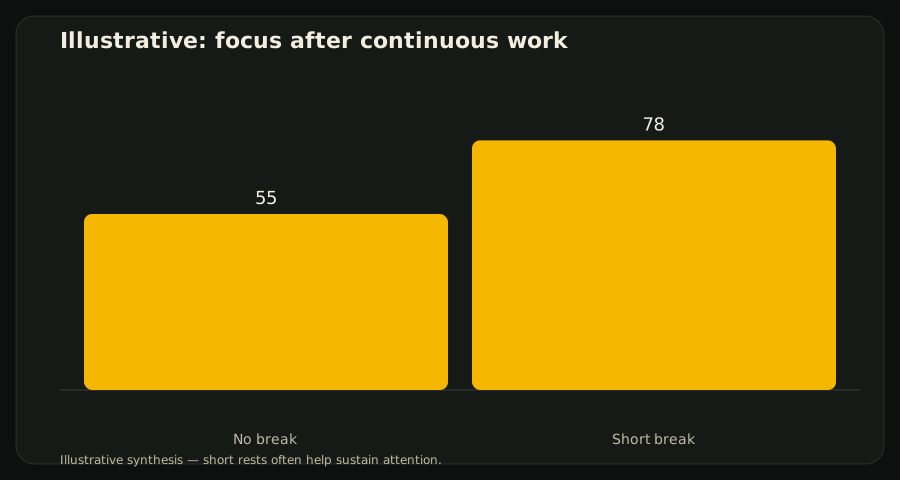
Fifteen minutes is a practical ceiling for many early-elementary sessions — not a law of nature.Illustrative: short rests often help sustain attention after continuous work.
Young attention is real — and finite. A “just finish the worksheet” hour often ends
in tears. A **15-minute rule** (work a short block, then pause) is a household
heuristic backed by a broader finding: **rest breaks support vigilance** better
than grinding without recovery.
## What the evidence suggests
Classic vigilance research and applied reviews show performance declines over
continuous monitoring and often recovers after brief rests (see discussions in
occupational and classroom break literature, e.g. summaries citing
[Helton & Russell](https://doi.org/10.1080/00140139.2015.1005045)
on vigilance decrement patterns). Classroom “brain break” studies similarly report
better on-task behavior after short activity or rest pauses
([CDC classroom physical activity](https://www.cdc.gov/physicalactivity/basics/adding-pa-to-schools.html)).
This is **not** a diagnosis tool and not proof that every child needs exactly
fifteen minutes. It is a starting rhythm: short enough to finish, long enough to
practice.
WHO and pediatric guidance also remind families that screens should not displace
sleep and movement
([WHO guidelines on physical activity and sedentary behaviour](https://www.who.int/publications/i/item/9789240015128)).
A break can be stretch, water, or outdoor air — not another autoplay video.
## Try this rhythm
1. Set a visible 10–15 minute practice or earn block.
2. Pause 3–5 minutes (move, drink, chat).
3. Optionally start another short block — or stop while goodwill remains.
## How EarnPlay fits
EarnPlay sessions are designed as **short rounds** that grant a fixed minute
block, then auto-relock — a built-in end to the bout. Pair unlocks with a real
break before the next earn. Product:
[EarnPlay](/projects/earnplay).
## References
- Helton, W. S., & Russell, P. N. (2015). Rest is still best —
- CDC — Adding physical activity to schools —
- WHO — Physical activity and sedentary behaviour guidelines —