# Screen-time gamification: turning iPad use into an educational experience
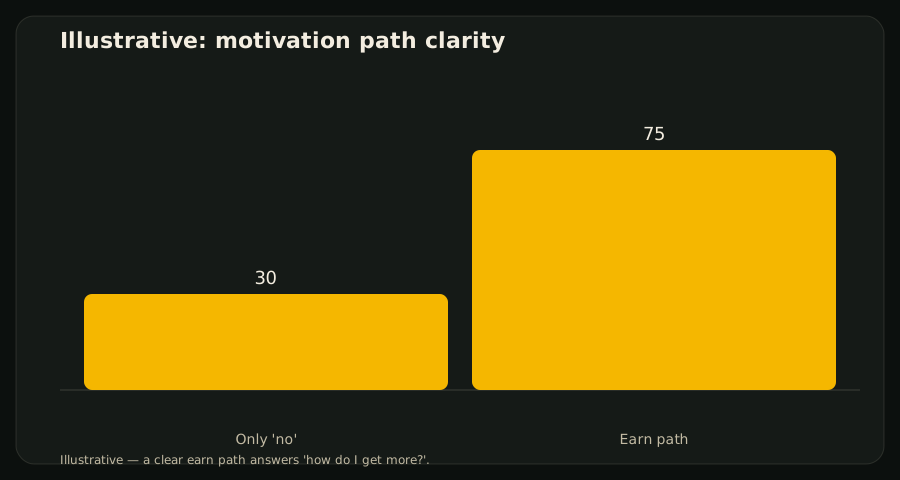
Gamification works best when the “win condition” is learning — not endless points.Illustrative: a clear earn path answers “how do I get more?” better than only saying no.
Parents already live inside a game economy: minutes of Minecraft or YouTube are the
currency kids care about. **Gamification** is not adding badges for fun. It is making
the rules of that currency explicit — and tying a short learning check to the unlock.
This is not clinical advice. It is product framing for households that want fewer
password fights and more letter, sound, and early-math reps.
## What research and guidance actually say
Self-determination theory highlights **autonomy, competence, and relatedness** as
drivers of lasting motivation
([Deci & Ryan overview](https://selfdeterminationtheory.org/theory/)).
Gamified systems that only pressure kids (shame, public leaderboards, “you lose”)
can backfire. Systems that give a **clear path to competence** — finish a check,
earn a reward — fit better.
Reviews of gamification in learning find mixed results overall, but stronger outcomes
when goals, feedback, and meaningful rewards align with the skill being practiced
(see summaries such as
[Hamari et al. on gamification](https://doi.org/10.1016/j.chb.2015.07.042)
and classroom-oriented guides from education agencies). Treat “points for everything”
as a red flag; treat **contingent, skill-linked rewards** as the useful pattern.
The American Academy of Pediatrics emphasizes **family media plans** and shared rules
over panic about every minute
([AAP Family Media Plan](https://www.healthychildren.org/English/fmp/Pages/MediaPlan.aspx)).
Gamifying screen time should sit inside that plan — not replace sleep, school, or
outdoor play.
## A routine you can try tonight
1. Pick one gated app (YouTube or a game).
2. Agree: three short learning checks → fifteen minutes.
3. Celebrate success; soft-retry mistakes (“let’s try again”).
4. When the timer ends, lock again — no living-room countdown.
## How EarnPlay fits
[EarnPlay](/projects/earnplay) is an earn-to-play layer on Apple Family Controls:
parents choose gated apps; kids complete mixed challenges; minutes unlock; shields
return automatically. Soft failure and positive copy match the motivation research
above. Read more in the
[parents community](/projects/earnplay/community).
## References
- Deci, E. L., & Ryan, R. M. — Self-Determination Theory:
- Hamari, J., Koivisto, J., & Sarsa, H. (2014). Does gamification work? —
- AAP Family Media Plan —